
ReMe Framework
1. Overview
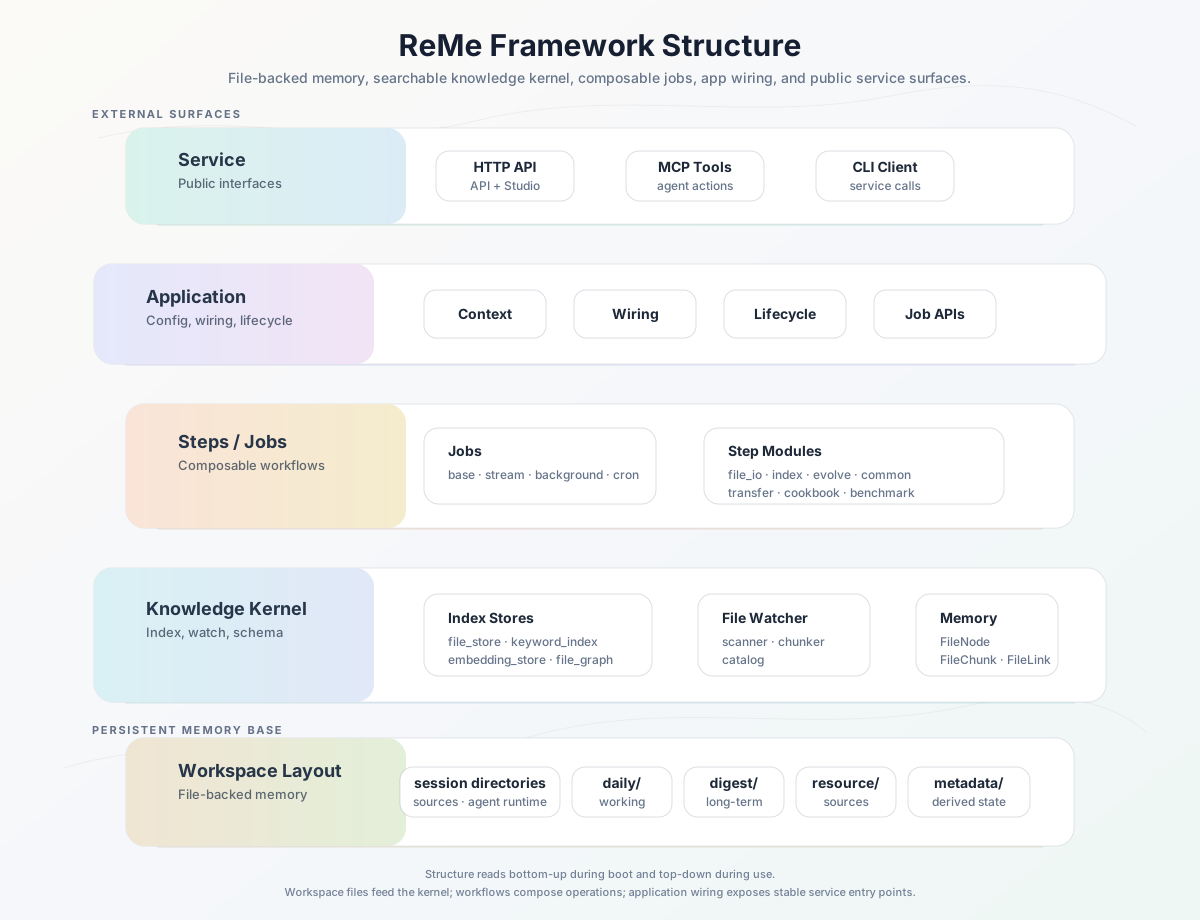
The ReMe runtime can be understood as follows: a configuration-driven Application assembles components and Jobs; the Service exposes service-enabled Jobs to the CLI, HTTP, or MCP; and each Job executes its Steps in sequence.
To run and use ReMe first, see Quick Start. For workspace file semantics, see Memory as File. User-facing guides for retrieval, automatic memory, and proactive reading are Memory Search, Auto Memory, Auto Resource, Auto Dream, and Proactive.
Capability Boundary
ReMe v4 focuses on long-term memory: it distills conversations and resources into daily/, organizes them into digest/, and exposes write, retrieval, and proactive-read capabilities through the CLI, HTTP, and MCP.
Single-session context-window management is outside the scope of ReMe v4. This includes compressing the current conversation, injecting summaries, trimming tool output, or providing an independent /compact interface. Those capabilities belong in the host agent framework. ReMe accepts conversations, resources, and file changes that have already occurred and persists the information with long-term value.
flowchart LR
    CLI["reme CLI<br/>reme/reme.py"] --> Client["Client<br/>http / mcp"]
    Client --> Service["Service<br/>HTTP / MCP"]
    Service --> App["Application<br/>reme/application.py"]
    App --> Jobs["Jobs<br/>base / stream / background / cron"]
    Jobs --> Steps["Steps<br/>reme/steps/**"]
    Steps --> Ctx["RuntimeContext<br/>data + Response + stream queue"]
    Steps --> Components["Components<br/>store / graph / index / llm / agent / catalog"]
    Components --> Workspace["Workspace<br/>daily / digest / resource / metadata"]
Core layers:
| Layer | Main location | Responsibility |
|---|---|---|
| CLI | reme/reme.py | Parse commands; start launches the service; other actions call the service through a client. |
| Service | reme/components/service/ | Register Jobs as HTTP endpoints or MCP tools. |
| Application | reme/application.py | Assemble configured objects, start them in dependency order, close them, and invoke Jobs. |
| Job | reme/components/job/ | Orchestrate Steps and select normal, streaming, background, or scheduled execution. |
| Step | reme/steps/ | Atomic business operations such as file I/O, retrieval, indexing, and self-evolution. |
| Component | reme/components/ | Reusable infrastructure such as file_store, file_graph, keyword_index, and agent_wrapper. |
| Schema | reme/schema/ | Data structures such as Request, Response, FileChunk, FileNode, and configuration models. |
| Config | reme/config/ | Default YAML configuration and command-line override parsing. |
2. Directory Structure
reme/
  reme.py                    # CLI entry point
  application.py             # Application assembly and lifecycle
  plugin.py                  # installed plugin contract and entry-point loader
  config/
    default.yaml             # default service / jobs / components
    cookbook.yaml            # Auto Fin + Daily Paper + DingTalk composition
    config_parser.py         # config=, dot notation, and env placeholder parsing
  components/
    component_registry.py    # backend registry and application-local copies
    base_component.py        # ComponentMixin / BaseComponent / bind dependency declarations
    runtime_context.py       # context for one Job execution
    job/                     # BaseJob / StreamJob / BackgroundJob / CronJob
    service/                 # HTTP / MCP services
    client/                  # HTTP / MCP clients
    file_store/              # file-index coordination layer
    file_graph/              # wikilink graph
    keyword_index/           # BM25 and other keyword indexes
    file_chunker/            # Markdown / JSON / JSONL / generic text chunking
    file_catalog/            # change checkpoints
    as_llm/, as_embedding/   # model wrappers
    as_decision_model/       # optional decision model adapters
    agent_wrapper/           # AgentScope / Claude Code / Codex wrappers
  steps/
    base_step.py             # BaseStep, Ref, dispatch_steps
    common/                  # version, help, health_check, status, chat
    file_io/                 # read/write/edit/delete/move/frontmatter/daily
    index/                   # watch/init/update/search/traverse
    evolve/                  # auto_memory, auto_resource, auto_dream, proactive
    transfer/                # upload/download
plugins/
  dingtalk/                  # independent DingTalk integration plugin distribution
  auto-fin/                  # independent example plugin distribution
  daily_paper/               # independent paper-research plugin distribution
integrations/
  claude_code/               # Claude Code adapter and marketplace
  hermes_agent/              # Hermes Agent memory-provider adapter
The default workspace directories are defined by ApplicationConfig:
<workspace_dir>/
  metadata/     # persistent file_store, file_graph, keyword_index, file_catalog, and related state
  session/      # source conversations used by memory workflows
  mem_session/  # generated Agent wrapper sessions and configuration
  resource/     # external resources
  daily/        # lightly processed memory
  digest/       # long-term digest memory
Application.__init__() first ensures that these directories exist, then initializes the service, components, and Jobs.
3. Startup and Call Chain
3.1 CLI
The entry point is reme/reme.py::main():
flowchart LR
    A["main()"] --> B["parse_args(*sys.argv[1:])"]
    B --> C{action}
    C -->|" start "| D["load_env()"]
    D --> E["resolve_app_config(**kwargs)"]
    E --> F["precheck_start(service)"]
    F --> G["ReMe(**config).run_app()"]
    C -->|" find_reme "| H["cli_find_reme()"]
    C -->|" other actions "| I["call_server(action, **kwargs)"]
    I --> J["R.get(ComponentEnum.CLIENT, backend)"]
    J --> K["client(action=action, **kwargs)"]
Start a service in one terminal and leave it running; omit config to use the default configuration:
reme startFrom another terminal, call Jobs through the running service:
reme version
reme search query="memory" limit=5
reme search query="memory" backend=mcp
Configuration parsing supports:
| Capability | Source | Description |
|---|---|---|
| Default configuration | resolve_app_config() | Load reme/config/default.yaml when config is not specified. |
| Explicit configuration | config=<name-or-path> | Accept a built-in configuration name or a YAML/JSON file path. |
| Dot notation | parse_dot_notation() | For example, service.port=8181. |
| Environment variables | _expand_env_vars() | Support ${VAR} and ${VAR:-default}. |
| Value conversion | _convert_value() | Convert bool, int, float, JSON list/dict, and null values automatically. |
3.2 Service
BaseService.run_app() executes in this order:
Set the optional service.jobs list to restrict HTTP or MCP exposure to those job names. If omitted, all jobs with enable_serve: true remain eligible; an empty list exposes none. The whitelist does not override enable_serve: false. When the list is configured, a missing, disabled, unsupported, or invalid selected job fails service startup.
flowchart LR
    A["Service.build_service(app)"] --> B["read app.context.jobs"]
    B --> C{"enabled and selected by service.jobs?"}
    C -->|yes| D["Service.add_job(job)"]
    C -->|no| E["skip registration"]
    D --> F["Service.start_service(app)"]
    E --> F
    F --> G["app.start() during lifespan"]
    G --> H["Application starts jobs"]
HTTP service behavior:
| Job type | HTTP exposure |
|---|---|
Non-StreamJob with enable_serve: true | POST /<job.name> returning Response JSON. |
StreamJob | POST /<job.name> returning text/event-stream. |
enable_serve: false | No endpoint is registered. |
After registering Job endpoints, the HTTP service can also mount the ReMe Studio single-page application. The default is service.web_enabled=true. Builds are resolved from service.web_static_dir, REME_WEB_STATIC_DIR, the optional reme_studio package installed by the web and core extras, and source-tree locations such as reme_studio/dist-static. If no index.html is found, only the frontend is skipped and the Job API remains available. The Studio GET fallback does not replace existing POST /<job.name> routes.
MCP service behavior:
| Job type | MCP exposure |
|---|---|
Non-StreamJob with enable_serve: true | Registered as an MCP tool. |
StreamJob | Currently skipped and not registered. |
BackgroundJob | Forces enable_serve=False at construction and is never exposed. |
MCP services can inject server-owned arguments with injected_job_kwargs; callers cannot override those arguments. Set tool_error_on_failure: true to expose an unsuccessful ReMe Response as an MCP tool error.
4. Registry and Dependency Injection
4.1 Global Registry R
ReMe uses the process-wide singleton R = ComponentRegistry(). Every component, Job, and Step is registered with @R.register("name").
from ...components import R


@R.register("version_step")
class VersionStep(BaseStep):
    ...
The registry key is:
(component_type, register_name) -> classcomponent_type comes from a class attribute:
| Type | Class attribute |
|---|---|
| Step | BaseStep.component_type = ComponentEnum.STEP |
| Job | BaseJob.component_type = ComponentEnum.JOB |
| Service | BaseService.component_type = ComponentEnum.SERVICE |
| FileStore | BaseFileStore.component_type = ComponentEnum.FILE_STORE |
The same backend name can therefore exist under different component types. For example, http can be both a service backend and a client backend.
ComponentEnum provides the built-in identifiers, but installed plugins may declare a new type with a namespaced string such as example.reranker. Custom identifiers use lowercase letters and numbers separated by ., _, or -. They are configured under components and participate in the same dependency ordering and lifecycle as built-ins.
4.2 Built-in and Plugin Registration
Built-in implementations populate the built-in registry through package imports. ReMe freezes that template after bootstrap, and each Application receives a mutable copy. Runtime code resolves backends through the application's registry rather than changing the process-wide template. ReMe then loads only the installed plugins explicitly named by plugins in the resolved configuration. A plugin exposes its package through the reme.plugins Python entry-point group. The package's plugin.yaml has two optional mappings: backends maps registration names to module:Class targets, and application_defaults contributes a low-priority ApplicationConfig fragment. The entry-point name is the plugin's identity. Plugins are enabled explicitly through the application config's plugins list or a plugins=[...] CLI override. Plugin registration therefore stays local to one application; duplicate (component_type, backend) providers fail during assembly instead of overwriting each other.
The legacy Python Plugin descriptor and reme.configs entry points remain accepted during migration. Configuration files can use extends to inherit another built-in, legacy plugin, or file-based configuration. See the independently packaged DingTalk, Auto Fin, and Daily Paper plugins.
Plugin packages are managed locally and remain separate from per-application activation:
reme plugins list
reme plugins install plugins/dingtalk
reme plugins install plugins/auto-fin
reme plugins install plugins/daily_paper
reme plugins show daily-paper
reme plugins validate daily-paper
reme plugins uninstall daily-paper

reme start config=cookbook
These management commands use the current Python interpreter's pip and never run through an HTTP or MCP service. The built-in cookbook configuration composes the three plugins, adds DingTalk delivery to the two report pipelines, and starts the DingTalk Agent bridge as a background Job. Enabling Auto Fin or Daily Paper alone keeps it independent from DingTalk.
4.3 Component.bind
Dependencies between components are declared with BaseComponent.bind(). At startup, Application._topological_order() reads every component's dependencies and starts them in topological order.
flowchart LR
    A["Component.__init__<br/>self.keyword_index = self.bind(...)"] --> B["Dependency placeholder"]
    B --> C["Application._topological_order()"]
    C --> D["component.start()"]
    D --> E["_resolve_bindings()"]
    E --> F["self.keyword_index = app_context.components[type][name]"]
    F --> G["component._start()"]
Rules for BaseComponent.bind(name, BaseClass, optional=True):
| Scenario | Behavior |
|---|---|
name is empty | Return None and skip the dependency. |
app_context exists | Look up app_context.components[ctype][name]. |
Dependency missing and optional=True | Resolve to None. |
Dependency missing and optional=False | Fail at startup. |
| Standalone mode | A private component can be created with default_factory. |
4.4 Step.Ref
Steps do not participate in component topological startup. They are created temporarily for each Job invocation. Steps access components primarily through BaseStep.Ref:
file_store: BaseFileStore = Ref(BaseFileStore, ComponentEnum.FILE_STORE)
agent_wrapper: BaseAgentWrapper = Ref(BaseAgentWrapper, ComponentEnum.AGENT_WRAPPER, optional=True)
Resolution priority:
flowchart LR
    A["access self.file_store"] --> B{"same-named object in kwargs?"}
    B -->|yes| C["use kwargs object"]
    B -->|no| D{"same-named object in context.data?"}
    D -->|yes| E["use context object"]
    D -->|no| F["read name from kwargs['file_store']; default is default"]
    F --> G["app_context.components[FILE_STORE][name]"]
A Step configuration can therefore specify:
steps:
  - backend: update_catalog_step
    file_catalog: resource
Here, file_catalog: resource means to resolve the file_catalog component named resource.
5. Application Lifecycle
The Application converts configuration into runtime objects and starts and closes them in order.
flowchart LR
    A["Application(**kwargs)"] --> B["ApplicationContext(**kwargs)<br/>parse ApplicationConfig"]
    B --> C["_setup_workspace_directories()"]
    C --> D["_init_service()"]
    D --> E["_init_components()"]
    E --> F["_init_jobs()"]
    F --> G["run_app()"]
    G --> H["service.run_app(app)"]
Startup order in Application._start():
flowchart LR
    A["create optional thread_pool"] --> B["topologically sort components"]
    B --> C["start components"]
    C --> D["start BaseJob"]
    D --> E["start StreamJob"]
    E --> F["start BackgroundJob"]
    F --> G["start CronJob"]
During shutdown, objects in _started_components are closed in reverse order so dependents close before their dependencies.
6. Job Model
A Job is the orchestration unit for an externally callable capability or background task. Jobs are configured under jobs: in reme/config/default.yaml.
6.1 BaseJob
BaseJob is the most common request-oriented Job:
flowchart LR
    Caller["Caller"] --> Job["BaseJob<br/>job(**kwargs)"]
    Job --> Ctx["RuntimeContext<br/>merged_kwargs"]
    Ctx --> S1["Step 1<br/>await step(context)"]
    S1 --> D1["read/write context.data / response"]
    D1 --> S2["Step 2<br/>await step(context)"]
    S2 --> D2["read/write context.data / response"]
    D2 --> Resp["context.response"]
    Resp --> Caller
Important source behavior:
| Source | Behavior |
|---|---|
_start() | Parse each Step config from YAML into (step_cls, params). |
_build_steps() | Create new Step instances for every call, avoiding state shared across requests. |
__call__() | Create a RuntimeContext and execute Steps sequentially. |
| Exception handling | Catch the exception, set response.success=False, and set answer=str(e). |
6.2 StreamJob
StreamJob extends BaseJob but returns streaming chunks:
| Behavior | Description |
|---|---|
| Context | Includes stream_queue. |
| Step output | Call context.add_stream_string(text, ChunkEnum.CONTENT). |
| Exception | Write ChunkEnum.ERROR. |
| Completion | Always send a DONE chunk. |
6.3 BackgroundJob
BackgroundJob runs long-lived loops such as file watchers. Its constructor forces enable_serve=False.
flowchart LR
    A["Application starts BackgroundJob"] --> B["_start() creates stop_event and task"]
    B --> C["_run_with_supervisor()"]
    C --> D["await self()"]
    D --> E{"exception?"}
    E -->|no, returned normally| F["finish"]
    E -->|yes and supervisor = True| G["exponential backoff + jitter"]
    G --> C
    E -->|yes and supervisor = False| H["raise exception"]
    I["close()"] --> J["stop_event.set()"]
    J --> K["wait close_timeout; cancel on timeout"]
The default BackgroundJob.__call__() also executes configured Steps in sequence, but it does not swallow exceptions, which allows the supervisor to restart the task.
6.4 CronJob
CronJob extends BackgroundJob with a cron expression:
jobs:
  nightly_dream:
    backend: cron
    cron: "0 3 * * *"
    steps:
      - backend: dream_extract_step
      - backend: dream_integrate_step
      - backend: dream_finish_step
The current implementation uses croniter to calculate the next trigger time. The timezone comes from app_config.timezone.
6.5 Default Job Types
flowchart LR
    Jobs["default.yaml jobs"] --> BG["background<br/>index_update_loop<br/>resource_watch_loop<br/>digest_watch_loop"]
    Jobs --> Cron["cron<br/>dream_cron<br/>proactive_refresh_cron<br/>optimize_index_cron"]
    Jobs --> Stream["stream<br/>chat"]
    Jobs --> Base["base<br/>version / help / health_check / status / app_config<br/>search / node_search / traverse / graph_snapshot / reindex<br/>read / load / read_image / write / save / edit / delete / move / list / stat / frontmatter_*<br/>daily_list / daily_reindex / daily_write<br/>auto_memory / auto_memory_cc / auto_resource / auto_dream / proactive_refresh / proactive_read"]
7. Step Model
A Step is a concrete business action. Every Step extends BaseStep and implements execute().
flowchart LR
    A["Job._build_steps()"] --> B["Step.__init__()"]
    B --> C["load prompt<br/>class-named YAML + prompt_dict override"]
    C --> D["Step.__call__(context, **kwargs)"]
    D --> E["clear Ref cache"]
    E --> F["RuntimeContext.from_context()"]
    F --> G["input_mapping"]
    G --> H["execute()"]
    H --> I["output_mapping"]
    I --> J["return result"]
7.1 RuntimeContext
RuntimeContext is shared by all Steps within one Job invocation:
| Field | Description |
|---|---|
response | Final Response(answer, success, metadata). |
data | Free-form dictionary containing input parameters and intermediate results. |
stream_queue | Output queue for streaming Jobs. |
stop_event | Stop signal for background Jobs. |
Common Step code:
assert self.context is not None
query = self.context.get("query", "")
self.context["processed_query"] = query.strip().lower()
self.context.response.answer = "..."
self.context.response.metadata["key"] = "value"
return self.context.response
7.2 input_mapping / output_mapping
BaseStep.__call__() invokes RuntimeContext.apply_mapping() before and after execution:
steps:
  - backend: some_step
    input_mapping:
      user_query: query
    output_mapping:
      result: final_result
The semantics are to copy context.data[source] to context.data[target].
7.3 dispatch_steps
Some Steps produce batches of events and dispatch them to other Steps. BaseStep.dispatch_steps() resolves and executes child Steps according to configuration.
Example from the default configuration:
index_update_loop:
  backend: background
  watch_dirs: [ daily_dir, digest_dir ]
  watch_suffixes: [ md ]
  steps:
    - backend: init_changes_step
      monitor_type: file_store
      monitor_name: default
      dispatch_steps: [ update_index_step ]
    - backend: watch_changes_step
      dispatch_steps: [ update_index_step ]
Flow:
flowchart LR
    Init["init_changes_step"] --> Batch["changes batch"]
    Watch["watch_changes_step"] --> Batch
    Batch --> Dispatch["dispatch_steps(...)"]
    Dispatch --> Update["update_index_step"]
    Update --> Store["file_store"]
8. Components in the Default Configuration
Current default components in reme/config/default.yaml:
| ComponentEnum | Name | Backend | Description |
|---|---|---|---|
service | singleton | http | Default HTTP service. |
tokenizer | default | regex | BM25 tokenizer. |
as_embedding | default | Not configured by default; example uses openai | Provides the embedding model wrapper after uncommenting the example config. |
as_decision_model | default | Not configured by default; example uses agentscope | Optional probabilistic decision model; demonstrated by the decision_demo config extending default. |
embedding_store | default | Not configured by default; example uses local | Depends on as_embedding: default after uncommenting the example config. |
as_llm | default | ${LLM_BACKEND:-openai} | LLM model wrapper. |
agent_wrapper | default | agentscope | AgentScope wrapper. |
agent_wrapper | claude_code | claude_code | Claude Code wrapper. |
agent_wrapper | codex/codex_oauth | codex | Codex wrappers for API-key and OAuth authentication. |
file_graph | default | local | Wikilink graph. |
file_catalog | default/resource/digest/dream | local | File-change checkpoints. |
file_chunker | markdown | markdown | Markdown AST chunking. |
file_chunker | json/jsonl/default | json/jsonl/default | JSON, JSONL, and generic text chunkers; generic text supports txt and log. |
keyword_index | default | bm25 | BM25 keyword index. |
file_store | default | local | Combines file_graph and keyword_index; defaults to embedding_store: "". |
Note that the search Step configuration contains vector_weight, but file_store.default.embedding_store is empty by default. Vector retrieval is available only when the runtime configuration enables an embedding store.
9. Adding a Step
9.1 Minimal Step
Suppose you want to add a Step that converts input text to uppercase.
Create a file such as reme/steps/common/uppercase.py:
from ..base_step import BaseStep
from ...components import R


@R.register("uppercase_step")
class UppercaseStep(BaseStep):
    async def execute(self):
        assert self.context is not None
        text = self.context.get("text", "")
        result = str(text).upper()

        self.context["uppercase_text"] = result
        self.context.response.answer = result
        self.context.response.metadata["length"] = len(result)
        return self.context.response
9.2 Registering the Step
Make sure reme/steps/common/__init__.py imports the new module. Add:
from . import uppercaseThe reason is that @R.register("uppercase_step") only executes after the module is imported.
9.3 Accessing Components
If a Step needs an existing component, prefer the Refs provided by BaseStep:
class MySearchStep(BaseStep):
    async def execute(self):
        assert self.context is not None
        results = await self.file_store.keyword_search(
            self.context.get("query", ""),
            limit=5,
        )
        ...
Common attributes available directly:
| Attribute | Component resolved by default |
|---|---|
self.as_llm | .model from as_llm: default. |
self.agent_wrapper | agent_wrapper: default; optional. |
self.file_catalog | file_catalog: default; optional. |
self.file_store | file_store: default. |
To select a non-default component from Job configuration:
steps:
  - backend: my_step
    file_catalog: dream
9.4 Step Design Guidance
| Guidance | Reason |
|---|---|
Read input from context and write intermediate results to context. | A multi-Step Job passes data through the same context. |
Write the final result to context.response. | Services and clients consume the standard Response. |
| Do not store request-scoped state on a Step instance. | A Step is rebuilt for every Job call, and stateless Steps are easier to test. |
A background loop that supports interruption should check context.stop_event. | BackgroundJob.close() relies on the stop event for graceful shutdown. |
Call add_stream_string() only from a StreamJob. | A normal Job has no stream queue. |
9.5 Unit Test Example
A Step can be instantiated directly and passed a RuntimeContext:
import pytest

from reme.components.runtime_context import RuntimeContext
from reme.steps.common.uppercase import UppercaseStep


@pytest.mark.asyncio
async def test_uppercase_step():
    ctx = RuntimeContext(text="hello")
    resp = await UppercaseStep()(ctx)
    assert resp.answer == "HELLO"
    assert ctx["uppercase_text"] == "HELLO"
10. Adding a Job
A Job usually requires no new Python class; configure existing Steps instead. Add a new Job backend only when a new execution model is required.
10.1 Adding a Normal Request Job
Save a configuration such as /path/to/uppercase.yaml, inheriting the default service and adding the Job:
extends: default

jobs:
  uppercase:
    backend: base
    description: "Convert text to uppercase."
    parameters:
      type: object
      properties:
        text:
          type: string
          description: "input text"
      required:
        - text
    steps:
      - backend: uppercase_step
Start that configuration in one terminal and leave it running:
reme start config=/path/to/uppercase.yamlFrom another terminal, call the Job:
reme uppercase text="hello"Call chain:
flowchart LR
    CLI["CLI<br/>reme uppercase text=hello"] --> HTTP["HTTP Client"]
    HTTP --> Req["POST /uppercase"]
    Req --> S["HttpService"]
    S --> J["uppercase BaseJob<br/>job(text='hello')"]
    J --> Step["uppercase_step<br/>await step(context)"]
    Step --> Resp["context.response.answer = HELLO"]
    Resp --> JSON["Response JSON"]
    JSON --> CLIOut["CLI prints answer"]
10.2 Adding a Multi-Step Job
A Job can chain multiple Steps:
jobs:
  demo_echo:
    backend: base
    description: "Normalize query, then echo it."
    parameters:
      type: object
      properties:
        query:
          type: string
          default: ""
        min_score:
          type: number
          default: 0.5
    steps:
      - backend: demo_echo_step1
      - backend: demo_echo_step2
The first Step writes:
context["processed_query"]
context["adjusted_min_score"]
The second Step reads those fields and writes the final response.
10.3 Adding a Stream Job
Use backend: stream in configuration:
jobs:
  stream_uppercase:
    backend: stream
    description: "Stream uppercase text."
    parameters:
      type: object
      properties:
        text:
          type: string
      required:
        - text
    steps:
      - backend: uppercase_prepare_step
      - backend: uppercase_stream_step
Example streaming Step:
from ..base_step import BaseStep
from ...components import R
from ...enumeration import ChunkEnum


@R.register("uppercase_stream_step")
class UppercaseStreamStep(BaseStep):
    async def execute(self):
        assert self.context is not None
        for ch in self.context.get("uppercase_text", ""):
            await self.context.add_stream_string(ch, ChunkEnum.CONTENT)
        return self.context.response
10.4 Adding a Background Job
Use backend: background in configuration:
jobs:
  my_watch_loop:
    backend: background
    watch_dirs: [ daily_dir ]
    watch_suffixes: [ md ]
    steps:
      - backend: init_changes_step
        monitor_type: file_store
        monitor_name: default
        dispatch_steps: [ update_index_step ]
      - backend: watch_changes_step
        dispatch_steps: [ update_index_step ]
Characteristics of a background Job:
| Characteristic | Description |
|---|---|
| Not externally exposed | BackgroundJob.__init__() forces enable_serve=False. |
| Has a supervisor | Restarts with exponential backoff after an exception by default. |
| Has a stop event | Notifies the loop to exit during close. |
| Suitable for watching/consuming | File watching, queue consumption, and periodic long-running loops. |
10.5 Adding a Cron Job
Use backend: cron in configuration:
jobs:
  daily_auto_dream:
    backend: cron
    cron: "30 3 * * *"
    steps:
      - backend: dream_extract_step
        file_catalog: dream
      - backend: dream_integrate_step
      - backend: dream_finish_step
        file_catalog: dream
An invalid cron expression fails at startup.
10.6 When a New Job Backend Is Needed
Most use cases require only a new Step plus a YAML Job. Consider adding reme/components/job/*.py only in these cases:
| Requirement | New Job class? |
|---|---|
| Add a business command | No; use backend: base. |
| Chain existing steps | No; use steps:. |
| Need SSE/streaming output | No; use backend: stream. |
| Need a background loop | No; use backend: background. |
| Need cron scheduling | No; use backend: cron. |
| Need entirely new scheduling, concurrency, or transaction semantics | Yes; add a Job backend. |
Minimal shape of a new Job backend:
from .base_job import BaseJob
from ..component_registry import R


@R.register("my_job_backend")
class MyJob(BaseJob):
    async def __call__(self, **kwargs):
        # custom scheduling logic
        return await super().__call__(**kwargs)
Also ensure the module is imported by reme/components/job/__init__.py.